Friday, 4 November 2022

Poll: Voters say U.S. is on the ‘wrong track,’ want climate solutions

Nearly three-quarters of U.S. voters say the country is on the “wrong track,” according to a new poll from the Conservative Energy Network.

The annual national survey from CEN, a coalition of 24 state-based conservative clean energy organizations, asked 1,000 registered voters about clean energy, climate change solutions, market competition and other related policy issues.

Four in five voters told CEN that they think candidates should clearly state their views on clean energy and climate change issues.

But the results of a non-climate related question were front and center: 72% said the country is on the “wrong track.” CEN said that is an all-time high for the seven years it has conducted the survey and that voters’ pessimism will likely drive voters to the polls in droves.

Notably, CEN found Democrats and Republicans showed equally high levels of voter intensity, putting the battle for control of Congress and state legislatures in the hands of third- and no-party voters. Among independents, men are leaning toward Republican candidates and women are more likely to support Democrats.

The poll also found, for the first time ever, that a majority of voters (51%) support Republicans’ efforts to address climate change. That number is up 10% from the 2020 survey and CEN noted it followed the release of the House Republican Energy, Climate and Conservation Task Force’s policy recommendations.

Further, 78% of those polled support passage of the Growing Climate Solutions Act, a bill that passed the U.S. Senate with the support of 47 Republicans.

“Our survey results make clear that economic issues are at the top of voters’ minds as they cast their votes — and rightfully so,” said Tyler Duvelius, CEN director of external affairs.

“With 47% of Americans believing their electricity bills are higher than average, it is more important than ever that the United States embrace an all-of-the-above approach to energy policy. Our survey found that Americans want more emphasis placed on all forms of energy — particularly wind and solar power. More domestically produced energy will lower our electricity costs here at home and will forge America’s path to a clean energy future.”

Public Opinion Strategies conducted the poll Oct. 24-27 via an online survey. It has a margin of error of plus or minus 3.53 percentage points.

The post Poll: Voters say U.S. is on the ‘wrong track,’ want climate solutions appeared first on Florida Politics - Campaigns & Elections. Lobbying & Government..

For Pensacola owners, trees are an important part of any landscape, but they also need to be maintained and trimmed properly to avoid becoming a hazard.

Neglecting to trim or remove trees can lead to dangerous situations, such as limbs falling on homes or people, or roots growing into the foundation of your home.

Pensacola Tree Service is the perfect solution for all your tree maintenance needs. We have experienced professionals who will take care of your trees quickly and safely.


source https://floridapolitics.com/?p=568777

Thursday, 3 November 2022

Bob Cortes: The coveted Hispanic vote

Here we are with another election cycle ending, less than a week away from the 2022 Elections.

Every cycle, I hear about how the Republican and Democratic parties are trying to “get” the Hispanic vote. With over 25% of Florida’s population being Hispanic, anyone can see why this is an important bloc for any campaign.

But when I read about how the respective parties are going about trying to do it, I can’t help but ask myself, “what are they thinking?”

This is not rocket science.

First, it is a mistake to think of Florida’s Hispanic population as monolithic. Our largest Hispanic group is Cuban, followed very closely by Puerto Ricans. Other larger groups include Mexicans, Venezuelans, Colombians and Brazilians, but truly every Latin American nationality is represented in Florida.

Diversity creates challenges, and there are distinct differences between nationalities.

For instance, Cubans may have a different attitude toward immigration issues than Puerto Ricans since Puerto Ricans are already citizens; and Mexicans are certainly going to have a different attitude toward border issues than other groups.

Yes, Venezuelans or Nicaraguans may be fleeing tyranny, and that can lead them to be single-issue type voters. My good friend William Diaz, president of Casa de Venezuela, always says, “I am a Democrat in registration, but my Party is Venezuela. I will vote for the candidate that supports policies that help the people of Venezuela fight the socialist Maduro regime.”

Often considered the “swingiest” of the swing Hispanic voters, Puerto Ricans are this way because of their migration pattern. The first wave of Puerto Ricans who moved to Florida many years ago did not come directly from Puerto Rico. Many retired from their jobs in places like New York, Chicago, Massachusetts and other northern states where they were registered Democrats.

Hence, many Puerto Ricans from that wave are registered Democratic, not Republican.

The latest wave of Puerto Ricans came directly from the island shortly after Hurricane Maria. Many who established residency in Florida did not understand the ideologies of the parties and mostly registered as NPA.

These voters are more in tune with issues of interest and concern back on the island at home such as statehood and self-determination. Many from this wave also have a large distrust in government and are very anti-establishment, as they view the government in Puerto Rico as corrupt.

Those who have relocated to Florida are determined to live the American Dream, just like anyone else who has been able to achieve this in Florida and are very much pro-free markets.

Other Hispanic ethnicities may be focused on other issues. El Salvadoreans may be fleeing violence. Hispanic Caribbeans may be fleeing hurricanes. Argentines or Colombians may be fleeing economic uncertainty.

It is on this last point that we find a common thread among all the Hispanic ethnic groups. Almost every Hispanic born in another country comes to Florida for one thing: economic freedom and opportunity.

Almost all of us are economic refugees in one way or another.

So, what are the issues of importance to Hispanics? Try the economy, jobs, schools, access to education and access to health care. Social issues are important but usually secondary to the issues mentioned above.

There are many avenues to court the Hispanic vote. One way is to message in the language and media closest to the Hispanic voter. Many still listen to their favorite Spanish radio show or station. Others are glued to their favorite telenovelas.

Spanish-language digital and newspapers are still the most consistent media.

But gone are the days when a candidate or campaign could simply throw an ad in Spanish on radio and connect just because they made the effort. Hispanic voters need to hear about the issues just like everyone else.

And in my opinion, that is exactly why Republicans will sweep the elections this cycle and why Hispanics will overwhelmingly vote for Gov. Ron DeSantis and Sen. Marco Rubio in Florida.

The Democrat’s best communicator Bill Clinton said it succinctly: “It’s the economy, stupid.”

It is not difficult to reach Hispanics. Use their language. But always remember the universal language we all speak regardless of ethnic background is “money.”

Our families depend on it.

___

Former State Rep. Bob Cortes served as the Gov. Ron DeSantis Statewide Puerto Rican Outreach Chair in 2018.

The post Bob Cortes: The coveted Hispanic vote appeared first on Florida Politics - Campaigns & Elections. Lobbying & Government..

For Pensacola owners, trees are an important part of any landscape, but they also need to be maintained and trimmed properly to avoid becoming a hazard.

Neglecting to trim or remove trees can lead to dangerous situations, such as limbs falling on homes or people, or roots growing into the foundation of your home.

Tree Services in Pensacola is the perfect solution for all your tree maintenance needs. We have experienced professionals who will take care of your trees quickly and safely.


source https://floridapolitics.com/?p=568739

Vote with your feet: Post-pandemic Florida transplants twice as likely to be Rs as Ds

Since March 16, 2020, an estimated 394,000 active voters have flocked to Florida. They are twice as likely to be Republicans as they are to be Democrats.

Since that mid-March day — the day President Donald Trump announced the “15 Days to Slow the Spread” of the COVID-19 pandemic — 193,300 Republicans and 96,900 Democrats have moved to Florida, according to L2 data. The data reveals 393,800 Florida voters who chose the pandemic-era Sunshine State as their new home state and registered to vote here. As percentages, 46% are Republicans, 23% are Democrats and 29% are independents.

In total, about 3% of Florida active voters are voters who moved to the state after the start of the pandemic.

As the nation navigated the pandemic, the “Free State of Florida,” led by Gov. Ron DeSantis, became seen as a bastion by many fleeing what critics call draconian lockdowns and masking orders, as well as liberal policies on crime and spending. From July 2020 to June 2022, Florida’s net migration — the number of people moving to the state minus the number of residents leaving it — was 777,600, according to estimates from the Legislature’s Office of Economic and Demographic Research.

Voters “voting with their feet” is a tried-and-true concept in political science and theory. Florida emerging as a new mecca for conservatives is a concept that has been speculated — or even assumed — by political pundits.

“(Florida is) unique because people move to Florida in part because they’re selecting for the politics in the same way they move to Vermont,” statistician Nate Silver said on an Oct. 13 episode of the FiveThirtyEight Politics Podcast.

But when pressed by host Galen Druke for evidence, Silver had none to offer.

Florida stands alone

The strong Republican lean of transplants in Florida, particularly for a “purple state,” is a trend that sets the state apart from other large states. The number of Republicans who have moved to Florida alone exceeds the number of transplant voters in each of the two most populous states, California and Texas.

The majority of new residents who registered to vote in California and New York, the most populous blue states, have been Democrats, according to L2. California has seen 78,800 transplant Democrats, 22,900 transplant Republicans and 25,500 transplant independents. Meanwhile, New York has seen 31,600 Democratic, 10,400 Republicans and 15,500 independent transplants.

Texas, which may be most analogous to Florida in this scenario, has 86,500 Republican, 68,600 Democratic and 18,400 independent transplants, a split nowhere close to rivaling Florida’s. The new residents of neighboring Georgia tend to match the state’s growing friendliness to Democrats: 50,700 are transplant Democrats, 38,200 are transplant Republicans and 25,300 are transplant independents.

The partisan disparity in Florida is even more pronounced beginning later in the pandemic. Since Sept. 25, 2020 — the day DeSantis announced Florida would immediately enter its final phase of re-opening — the state has gained 161,500 new GOP Floridians and 77,300 Democrats. In the past 12 months, when COVID-19 and lockdowns have been more of an afterthought, Florida has picked up 62,500 Republican and 26,600 Democratic transplants.

It’s also a stark change from just four years prior, both in quantity and partisan affiliation.

When isolating new Floridians who arrived and registered to vote between March 14, 2016, and Sept. 29, 2018 (a period equivalent to the roughly 133 weeks between the start of the 15 Days to Slow the Spread and the end of L2 data for Florida on Oct. 1, 2022), the query returns 29,700 Republican, 22,000 Democrats and 17,000 independent transplants.

It should be noted that methodology misses voters who were considered active in 2018 but aren’t now — and picks up voters who weren’t active then but now are. Still, it sheds light on the uptick of transplants who are registering as Republicans.

Susan MacManus, University of South Florida professor emerita, told Florida Politics she was unsurprised that Republican transplants double their Democratic counterparts. Not only is it about quality of life, like lockdown policies and the environment, but record inflation could also have driven Americans to relocate over the past year.

“The thing about voting with your feet is that people that have the means to do so are more likely, whereas those who don’t can sometimes be trapped in areas that they are really not where they’d like to be,” MacManus said. “A lot of it has to do with the ability to move economically or if you had relatives or somebody else close by.”

In the 12-month run-up to the 2018 election (mostly, if not entirely, within the approximate five years L2 says its “new to state” metrics are reliable), Florida had 18,900 Republican, 13,900 Democratic and 10,700 independent transplants.

Of note, L2 uses the state definitions of active and inactive voters but also considers voters who have moved within a state but not registered to vote at their new addresses inactive voters, resulting in a count of active voters that is generally lower than a state’s count. Analyzing all voters instead of L2’s defined active voters negligibly changes the ratio of Republicans to Democrats.

‘Freedom’s vanguard’

During his State of the State address at the beginning of the 2022 Legislative Session, DeSantis declared Florida “freedom’s vanguard.”

The Sunshine State has become home to a series of conservative “MAGA” political commentators and influencers. Among them are Ben Shapiro and Dave Rubin, both of whom left Los Angeles for South Florida. Fox News’ Lisa Boothe chose “freedom-loving Florida” as her new home. Will Witt moved from California to Florida to launch The Florida Standard, a rising conservative outlet. DeSantis’ former Press Secretary, Christina Pushaw, is a similar transplant.

The list goes on.

A common thread among them is their distaste for liberal leadership in their previous states and their praise for DeSantis.

People like to be near people who are like them, said Myiah Hutchens, a professor at the University of Florida who researches partisan media. Florida’s decision to re-open schools may have been particularly palatable to some, like parents or those working or attending universities.

“Florida has been very vocal on a national stage about how they responded to COVID,” she told Florida Politics. “DeSantis’ current tagline for his run for Governor is ‘keep Florida free.’ That sort of messaging has played out a lot, and we’ve seen that nationally.”

L2’s data shatters the perception that transplants from liberal states are turning Florida blue. No state, only the District of Columbia, sent more Democrats than Republicans to Florida.

Of active, post-pandemic transplants who were last registered to vote in New York, of which there are 50,200, 43% are Republicans and 28% are Democrats. Similar shares, but half the voters, were last registered in New Jersey.

More than half of the transplant voters from Pennsylvania and Ohio have registered as Republicans. For those who merely crossed the border from Georgia, 49% are Republicans.

“Everybody knows people are moving down here from New York. Their number one question is, are they going to bring their party identification with them, which the assumption is that if they’re moving from New York, they must be liberal and they must be Democrat,” MacManus said. “Of course, the opposite is true.”

Will transplants turn Florida red?

Former Leon County Supervisor of Elections Ion Sancho, who held the role for 28 years until 2016 and who oversaw the hand recount in Miami-Dade County during the 2000 election, told Florida Politics that voting habits are determined by more than party affiliation. But he called the concept of Americans voting with their feet an interesting hypothesis.

“I think there’s a lot of validity to it, and I certainly think maybe that’s going into the polling disparity that you’re seeing currently,” Sancho said.

That polling disparity is the double-digit lead DeSantis has opened over Democratic challenger Charlie Crist in recent polls. As of Wednesday evening, Silver’s FiveThirtyEight predicts a 55%-43% popular vote split on Election Day and gives DeSantis a 98% chance of winning.

No Florida gubernatorial race has been decided by more than 2 percentage points since 2006, when Crist — then a Republican — was elected. Furthermore, no such race has been decided by 10 points since 2002, when Republican Gov. Jeb Bush was re-elected.

DeSantis was elected by less than half a percentage point in 2018.

But an influx of new Floridians hardly accounts for DeSantis’ projected runaway re-election. Doing some napkin math, assuming similar turnout in 2018 and a similar breakdown of independents between DeSantis and Democratic nominee Andrew Gillum, the DeSantis-Gillum vote margin would have moved from 49.6%-49.2% to 49.9%-48.9% had the post-pandemic new Floridians been around in 2018.

That year, the transplants would have only created an 0.6-point swing in the margin. Inverting the independent vote to instead give 54% of the new post-pandemic independents to DeSantis rather than Gillum — playing along with the fantastical rules of this DeSantis-generous scenario — would result in an 0.8-point swing.

While not enough to be the sole explanation for the impending blowout facing Democrats in Florida, the spike in new voters puts the state that much further from Democrats’ reach.

State Sen. Joe Gruters, the Chairman of the Republican Party of Florida, told Florida Politics the state GOP has been hammering Democrats under leadership from Trump and DeSantis. Principal to the state party’s mission are voter registration and voter turnout, the fruits of which will be revealed on Tuesday.

“They both spent a ton of money on voter registration for the respective leadups to their respective campaigns,” Gruters said. “You have all these political refugees, you have education refugees, you have economic refugees trying to escape to the land of freedom, which is Florida, and that’s where the Governor really gets a lot of credit for the policies that he helped shape over the years.”

More to the story

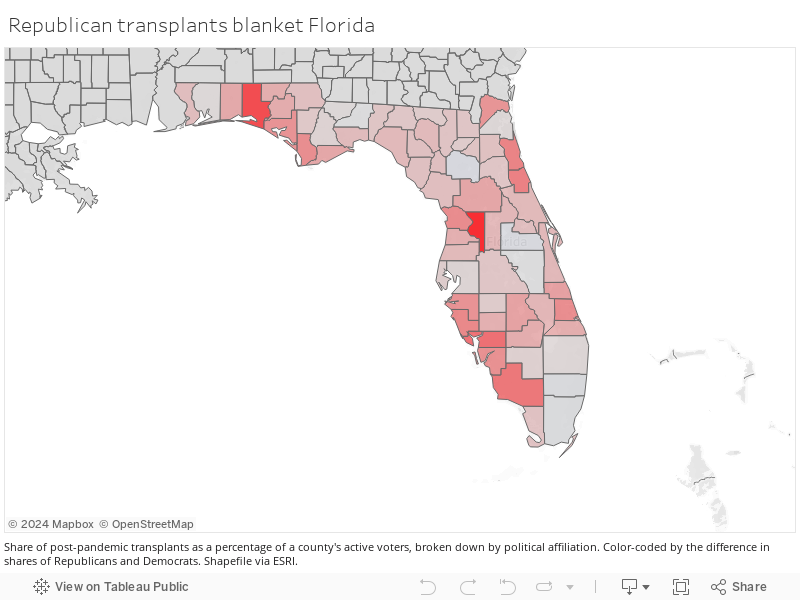
The effect of Americans voting with their feet since the start of the pandemic is most pronounced in Southwest Florida and the Panhandle.

In Charlotte County, 6.7% of active voters are transplants, and 3.7% are transplant Republicans. For Collier County, the share is 5.9% and 3.5%, respectively. For Sarasota County, it’s 6.3% and 3.3%; for Manatee County, it’s 5.7% and 3.0%; and for Lee County, it’s 5.5% and 2.8%.

In Walton County, 6.4% of active voters are transplants, and 4.2% are transplant Republicans. For Santa Rosa County, the share is 4.4% and 2.8%.

The disparity is most exaggerated in Central Florida’s Sumter County, one of the fastest-growing counties in the state. There, 9.0% of active voters are transplants, and 5.5% are Republican transplants.

The only counties that saw more Democrats arrive than Republicans are traditional Democratic strongholds.

Alachua County drew 1,114 Democratic transplants compared to 788 GOP transplants. Miami-Dade County received 3,715 Democratic and 2,533 Republican transplants. Broward, Leon, Orange and Osceola were the only other states that received more Democratic arrivals.

In November 2021, Republicans overtook Democrats in active registered voters in Florida, accomplishing the feat for the first time in Sunshine State history.

Sancho noted COVID-19 could spell a significant shift in Florida’s population, which is traditionally mobile. To him, a further question is what types of Republicans, Democrats and independents are Florida’s new residents. Are these “MAGA Republicans,” drawing from the more than three-fifths of Republicans nationwide who believe Trump won the 2020 election?

Hutchens took a stab at Sancho’s question. She guessed a decent amount of the Republican transplants watch Fox News or follow national conservative media.

“They’re probably going to be higher consumers of that, and Fox is still the largest,” Hutchens said. “We’re seeing increases in Breitbart and stuff like that, but not at the same rate as Fox. They’re probably not New York Times readers.”

Sancho wasn’t as certain about the nature of these new Floridians.

“It’s hard to say,” Sancho said. “Only in post-analysis and exit summaries could that kind of data have been examined and then developed. And it will be, I’m sure, because it’s marvelous data.”

The post Vote with your feet: Post-pandemic Florida transplants twice as likely to be Rs as Ds appeared first on Florida Politics - Campaigns & Elections. Lobbying & Government..

If you live in Florida, you need to remove a tree from your property, but you're not sure how to go about it or if it's even safe to do yourself.

Removing a tree can be a daunting task. If you don't know what you're doing, you could end up hurting yourself or damaging your property.

Pensacola Tree Service is here to help. We are experts in tree removal, stump grinding, and tree trimming. We will safely remove the tree from your property and leave your yard looking great.


source https://floridapolitics.com/?p=567801

Wednesday, 2 November 2022

Fernandina Beach Commissioners back extension of city golf course deal

It’s not “four more years,” but three, as the Fernandina Beach City Commission committed the city to three more years managing the municipal golf course.

The plan received vocal support before it was presented to the Commission.

“I was able to meet with the new Director and Assistant Director of (the city) Parks and (Recreation Department), and I was quite impressed by their program that they have for overseeing the golf course,” city Golf Course Advisory Board member John Pelican said. “I think both golfers and taxpayers will be happy with their oversight. I believe they can succeed in that mission, but I believe it will take your support.”

With the Commission’s backing, golf course management can keep and attract talent. The contract picks up where the present one runs out in 2023 and goes through Oct. 1, 2026.

“That would allow myself and staff to be able to hire leadership in that division, department, if you will, so that we can get someone that would want to come here and not just be here for less than a year,” new city Parks and Recreation Director Catherine Vorrasi said. 

“I’m very excited about having the opportunity to manage the golf course. Looking at it operationally, the pro shop, out at the course, and food and beverage, I’m very excited about the opportunities out there.”  

The city took temporary management of the course in May 2021 with city officials later deciding to extend that to Oct. 1 of this year, and in April moving that termination date out another year to 2023 on the recommendation of the Advisory Board.

“This is going to be the right call,” Commissioner Bradley Bean said shortly before the Commission’s unanimous vote in favor of the plan. “We’ve got to give the golf course some stability.”

Commissioner David Sturges can’t wait to see what’s next at the course, and has some ideas he’s shared with City Manager Dale Martin and intends to share with Vorrasi. 

“The golf course has been improving steadily since we’ve taken back management of it,” Sturges said. “It has been profitable this year, versus other years it hasn’t been. As well as, the staff has worked very hard they’ve been very productive.”

The post Fernandina Beach Commissioners back extension of city golf course deal appeared first on Florida Politics - Campaigns & Elections. Lobbying & Government..

If you live in Florida, you need to remove a tree from your property, but you're not sure how to go about it or if it's even safe to do yourself.

Removing a tree can be a daunting task. If you don't know what you're doing, you could end up hurting yourself or damaging your property.

Tree Services in Pensacola Florida are here to take on the job.  Click here for more details. We are experts in tree removal, stump grinding, and tree trimming. We will safely remove the tree from your property and leave your yard looking great.


source https://floridapolitics.com/?p=568342

UF selects Ben Sasse as its next President; conservative U.S. Senator pledges ‘political celibacy’

The University of Florida (UF) on Tuesday formally selected Ben Sasse as its next President, setting aside concerns that the appointment of a conservative Republican U.S. Senator from Nebraska would further politicize the state’s flagship higher education institution.

The university’s board of trustees — largely appointed by Republican Governors — voted unanimously to appoint Sasse, 50, as President. The outcome of the vote was never in doubt: There were no alternative candidates for the job. Sasse said he was resigning from the Senate by year’s end.

One trustee, Richard Cole, said Sasse calmed his concerns about hiring a politician. “I was very hesitant to think it was appropriate for us to bring in a politician,” Cole said. “You’ve overcome that for me.”

“I’m incredibly gratified,” Sasse said. He still faces formal approval by the Board of Governors, the panel that oversees all public universities in Florida. That was widely expected to happen. UF’s trustees also still must negotiate Sasse’s compensation, expected to be around $1.6 million.

Under questioning by trustees, Sasse said political issues that have been culturally divisive among progressives and conservatives “have almost nothing to do with most of the riddles we need to navigate.” He added: “Students aren’t machines and universities are not assembly lines,” he said.

Sasse pledged not to be involved in partisan political activities as university President and said he would urge Florida’s ruling Republican party not to micromanage the school. He called it “political celibacy,” after a similar pledge by Purdue University’s President, Indiana’s former Governor.

“It would be my plan, as I arrived here, to take a similar pledge to you all of political celibacy,” he said.

Asked whether the Governor’s Office helped his candidacy, Sasse said he did not speak to Gov. Ron DeSantis and hasn’t met with DeSantis since at least 2016. Florida’s Senate had previously said there were no records of communications between Sasse and top GOP legislative leaders there during the search process.

He described UF changing under his presidency — “higher education is going to need to change a lot” — to accommodate what he described as technological and economic disruptions and changing population demographics across Florida. He said some changes would be uncomfortable, and the university should serve not just young adults but students as old as 35.

Sasse said professors delivering lectures in classrooms wasn’t the best way to teach college students and endorsed what he called a “broader suite of experiential learning opportunities,” including internships, more laboratory settings and other hands-on learning experiences.

“Students aren’t machines and universities are not assembly lines,” he said.

Asked about liberal arts teaching at UF, Sasse agreed that was as important as workplace development and lessons about science, technology and mathematics. In what might have been a jab toward students protesting his hiring, Sasse lamented what he said was cancel culture prevalent on so many campuses.

“Where is the room to change your mind, to grow, to learn, to say you were wrong?” he said.

Sasse was the only finalist to replace the school’s outgoing President, Kent Fuchs, and become its 13th President. Sasse was president of a small private university for five years in Nebraska and holds a doctoral degree in history from Yale.

Sasse’s political positions — including his opposition to abortion rights and same-sex marriages — were deeply troubling to some students and faculty on the campus in one of Florida’s most progressive cities. Former President Donald Trump is no fan of the GOP Senator, either, calling him a “grandstanding, little-respected senator” following Sasse’s vote to convict Trump in his second impeachment trial. About 100 students protested behind barriers outside ahead of the vote on Sasse.

Sasse, who said he would resign from his job as Nebraska’s junior U.S. Senator where he has served since 2015, was formerly the President of tiny Midland University, a Lutheran-affiliated school in Fremont, Nebraska.

At Midland under Sasse, full-time enrollment doubled to nearly 1,300 students, and he was credited with helping the university avoid bankruptcy and eventually turn a profit at the end of his tenure.

Some former faculty members told UF’s campus newspaper, the Independent Florida Alligator, that a toxic workplace persisted under Sasse, and faculty were forced to sign a loyalty oath to keep their jobs that prevented them from disparaging Sasse or the university. It’s generally recognized that such oaths would be unconstitutional at a public university.

Sasse has opposed forgiveness of student loans, endorsed tenure reviews for faculty and praised hybrid college classes that include online components as especially effective.

With trustees meeting inside Emerson Alumni Hall on campus, police had surrounded the building with barricades to prevent student protesters from disrupting their vote. Inside the building, armed officers hovered visibly just a few feet behind the lectern where a dozen students and alumni delivered brief statements — nearly all critical of Sasse — ahead of the vote.

“Once again, political meddling has made UF the laughingstock of the academic community,” said Bryn Taylor, a doctoral student and co-president of Graduate Students United.

During Sasse’s appearance on campus last month, hundreds of student protesters surged inside the same building and disrupted question-and-answer sessions by chanting and banging on the building’s walls and doors. In an interview last week with the campus newspaper, Fuchs compared the student protests to the Jan. 6 insurrection in the U.S. Capitol.

To prevent similar disruptions Tuesday, Fuchs had warned students that UF would enforce a decades-old regulation that prohibits students from protesting inside campus buildings. Violators would be punished under student rules of conduct, which can include expulsions from the university.

Fuchs earned roughly $1.4 million in total compensation each year. UF’s President lives in a gated, multimillion-dollar mansion on campus next to the law school. Sasse was earning $174,000 from the Senate, and in August reported that he owned investments worth at least $1.3 million and carried a mortgage between $250,000 and $500,000.

Florida selected Sasse as the sole finalist for the job under a new state law passed by the Republican-led Legislature and signed by DeSantis that allowed the process to take place in secrecy. The university’s faculty senate voted 72-16 last week expressing no confidence in the selection process, citing a lack of transparency.

The head of the search committee, Rahul Patel, told donors on Oct. 15 that other finalist candidates he did not identify were sitting presidents of the nation’s top universities. “All of them had current positions,” Patel said, “made it very, very clear to us that they would not consent to being named, consent to be publicly named a finalist, unless they were the sole finalist.”

Sen. Jeff Brandes, a St. Petersburg Republican, who sponsored the law, has said lawmakers never intended the law to shield the identities of all but a single finalist. “The goal was to get to finalists, not announce who the person was as the only finalist,” he said.

The Chairman of the board of trustees, Mori Hosseini, said sitting university Presidents applied for the job because they were assured their identities would not be disclosed. “In this way, the new law helped us attract leaders from across the country that we could not do in the past,” he said.

Other schools — including the University of Michigan, University of Virginia and UC Berkeley — also named a sole finalist in their presidential searches, Hosseini said.

Patel said more than half of 12 candidates near the end of the process were women or people of color. Of six final candidates considered, Sasse was the only one who was not a current university President.

Sasse’s selection follows years of political storms under DeSantis and conservatives in the Legislature that have swirled over the school, even as the Governor’s administration has increased the university’s funding and allowed it to hire more professors. Under Fuchs, Florida rose to No. 5 among public university rankings with a $1 billion research endowment.

The political disputes have covered whether professors can testify in lawsuits against DeSantis, limits on how professors can talk in classrooms about racism in America, surveys of professors and students about their political beliefs, tenure reviews for professors, and whether UF — which recorded more COVID-19 cases than any other university in the U.S. — should have required vaccinations or masks in classrooms (it never did).

___

This story was produced by Fresh Take Florida, a news service of the University of Florida College of Journalism and Communications. The reporter can be reached at grace.banahan@freshtakeflorida.com. You can donate to support our students here.

The post UF selects Ben Sasse as its next President; conservative U.S. Senator pledges ‘political celibacy’ appeared first on Florida Politics - Campaigns & Elections. Lobbying & Government..

For Pensacola owners, trees are an important part of any landscape, but they also need to be maintained and trimmed properly to avoid becoming a hazard.

Neglecting to trim or remove trees can lead to dangerous situations, such as limbs falling on homes or people, or roots growing into the foundation of your home.

Pensacola Tree Service is the perfect solution for all your tree maintenance needs. We have experienced professionals who will take care of your trees quickly and safely.


source https://floridapolitics.com/?p=568067

Tuesday, 1 November 2022

2022 a record year for attendees at Equip Expo

If you’re in the Pensacola area, then you have probably already experienced the need for having to remove a tree or stump or getting your tree’s trimmed.

The cost of tree removal varies depending on a few factors, such as:

– The type of tree that needs to be removed

– The size of the tree

– The location of the tree

– The condition of the tree

Pensacola Tree Removal offers competitive pricing for our tree removal services.

For a full list of services Tree removal services visit Click for Tree Removal Services in Pensacola for a fast, friendly and reliable quote that you can count on.

This will help not only beautify your property but also is the safest way to do it.

Equip Expo's outdoor demo yard expanded 30 acres. (Photo: Equip Expo)

Equip Expo’s outdoor demo yard expanded 30 acres. (Photo: Equip Expo)

Equip Exposition said it set a new attendee record, welcoming more than 25,000 attendees and exhibitors. This year’s show debuted a new brand and new experiences for its participants. The show announced earlier in the summer that it sold out of all indoor and outdoor exhibit space available both Equip Exposition and Hardscape North America, who co-locates with Equip Expo.

“This year’s numbers show the industry is strong and optimistic about 2023. The industry continues to innovate and bring new technologies to markets evidenced by the major product announcements, education, networking that went on,” said Kris Kiser, President and CEO of the Equip Exposition and the Outdoor Power Equipment Institute (OPEI), which owns the trade show.

Expo attendees hailed from all 50 states and 49 countries, with the furthest traveling attendees journeying from Guam, New Zealand and Australia.

“The trade show remains the industry’s family reunion,” said Kiser. “This year we shook up the programming a bit and introduced lots of new ideas from an opening welcome reception and new, interactive educational sessions to Mulligan’s 5K Fun Run & Walk, a coffee bar and an expanded outdoor demo yard.”

Other new opportunities at this year’s show include landscaper educational sessions organized by Landscape Management magazine, as well as new partnerships with the Pool & Hot Tub Alliance and the Association of Outdoor Lighting Professionals.

More than 4,000 people turned out to the show’s first welcome reception at Louisville Slugger Field. Nearly 250 runners braved the cold temperatures at the inaugural Mulligan’s 5K Fun Run & Walk over the Big Four Pedestrian Bridge. The benefit run and walk, sponsored by Ariens, raised funds for the Kentucky Humane Society.

Next year’s show, which returns to the Kentucky Exposition Center, will be held Oct. 18-20, 2023.

The post 2022 a record year for attendees at Equip Expo appeared first on Landscape Management.


source http://treeremovalpensacola.wordpress.com/?p=218

Monday, 31 October 2022

Which nursing homes are Gold Seal worthy? Panel meets to discuss applicants

Six Florida nursing homes are vying for “Gold Seal” status. Members of the Governor’s Panel on Excellence in Long-Term Care will meet Tuesday to consider applications that were submitted by the facilities.

Two of the applicants, Village on the Green in Longwood and Mayflower Health Care Center in Winter Park, are submitting initial applications.

Village on The Green was cited with several deficiencies in a summer re-licensure survey. According to the report, the facility failed to provide necessary care to two patients; failed to prevent a decrease in range of motion for two residents; didn’t maintain all its survey results for the last three years for the public to review; failed to follow up on pharmacy recommendations for one resident; and failed to ensure that the food was kept at proper holding temperatures.

The deficiencies were corrected according to a Sept. 2 follow-up visit, documents show.

Mayflower Health Care Center has also had some recent deficiencies, according to the state website Florida Health Finder. An unannounced fire, safety, life inspection conducted in early August uncovered the facility was not maintaining its automatic sprinkler system through regularly scheduled inspections, was not executing twice-a-year drills for its comprehensive emergency management plan, and had fire doors that were not closing and locking.

A re-licensure survey for Mayflower conducted Aug. 3 resulted in the facility being cited for not following a doctor’s follow-up orders for one resident and failing to adhere to employment background screening for two staff members

A re-licensure survey for a replacement Mayflower facility was conducted In October, along with a new fire life safety survey after a new building on the same campus was opened. No violations were found in either survey.

The Gold Seal Program was established in statute to award and recognize nursing home facilities that demonstrate excellence in long-term care over a sustained period, promote the stability of the industry, and facilitate the physical, social and emotional well-being of nursing home facility residents. The Governor’s Panel on Excellence in Long-Term Care administers the program.

Gold Seal designations are generally awarded twice a year, and the designations are valid for two years.

There are 690 nursing home providers in Florida, but only 14 nursing homes are recognized as Gold Seal Facilities.

Meanwhile, the coveted designation for four of the 14 facilities expires at the end of the year. Those four facilities — Delaney Park Health and Rehabilitation Center in Orlando; River Garden Hebrew Home for the Aged in Jacksonville; Joseph L. Morse Health Center, Inc. in West Palm Beach; and Pavilion for Health Care in Penney Farms — have all submitted applications to keep their Gold Seal designation.

Members of the Governor’s Panel on Excellence in Long-Term Care will interview representatives from the nursing homes during its three-hour meeting. According to the agenda, the panel will consider testimony from the public. 

Panel members will make follow-up visits to facilities to ensure they meet necessary standards. The panel will announce the Gold Seal recipients before Dec. 15.

The post Which nursing homes are Gold Seal worthy? Panel meets to discuss applicants appeared first on Florida Politics - Campaigns & Elections. Lobbying & Government..

If you live in Florida, you need to remove a tree from your property, but you're not sure how to go about it or if it's even safe to do yourself.

Removing a tree can be a daunting task. If you don't know what you're doing, you could end up hurting yourself or damaging your property.

Tree Services in Pensacola Florida are here to take on the job.  Click here for more details. We are experts in tree removal, stump grinding, and tree trimming. We will safely remove the tree from your property and leave your yard looking great.


source https://floridapolitics.com/?p=567582

Diagnosis for 12.19.22: Checking the pulse of Florida health care news and policy

Welcome back to Diagnosis, a vertical that focuses on the crossroads of health care policy and politics. With less than a month to go in th...